Student collaborators of Christian Fendt |

|
|
I am (and also was) happy to collaborate with the following great students. |

| |
| Deniss' started his PhD work July 2011. He investigates the launching of jets and winds from disks applying a self-consistently derived magnetic field configuration. Outflow dynamics and field geometry are numerically derived from simulations using the PLUTO MHD code. The field structure is given by the evolution of a mean-field dynamo. Deniss' project is funded by the SFB 881 of German Science Foundation DFG. |
Deniss Stepanovs (Latvia) 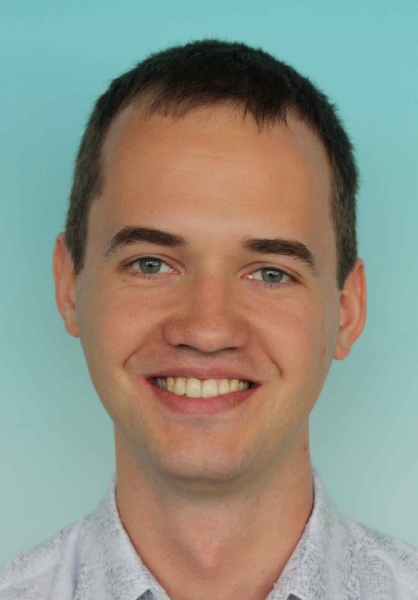
|
|
| |
| Somayeh started working with me as a guest PhD student March 2010 (she will formally graduate from Mashad university in Iran). She investigates MHD launching conditions of jets from accretion disks, applying numerical simulations using the PLUTO MHD code. The main questions are: what kind of disks launch jets?, when do disks launch jets?, and also what is the mass transfer rate from accretion to ejection? Somaye's work is funded by the SFB 881 of German Science Foundation DFG and a stipend by Mashad University. |
Somaye Sheiknezami (Iran) 
|
|
| |
|
Oliver started his PhD work August 2008.
He investigates the acceleration and collimation behavior of relativistic
MHD jets. MHD self-acceleration and self-collimation is known and understood for
non-relativistic jets. However, in relativistic MHD and rapid rotation the
electric field becomes important and is usually thought to have a de-collimating effect.
Oliver is applying
relativistic MHD simulations to
investigate these effects further. Oliver's project is funded by the International Max Planck Research School for Astronomy and Cosmic Physics at the University of Heidelberg. (IMPRS-HD). Oliver has 2011 moved to Leeds to work as as a Post-doc with Serguei Komissarov. We thank Andrea Mignone and collaborators for the opportunity to use the PLUTO numerical MHD code. |
Oliver Porth (Germany) 
|
|
| |
|
Bhargav
started his PhD work August 2008.
He investigates formation of outflows from massive young stars.
Although we understand the launching mechanism for jets from low mass young
stars reasonably well, the formation mechanism for their high mass siblings
have not yet been investigated. Are these jets magnetically launched? How is collimation obtained and maintained in the hot and dense environment? How do the jet-launching disk compare to their low-mass counterparts? High-mass star formation observer Henrik Beuther joins our team as co-supervisor. We thank the Klaus Tschira Foundation (KTS) and the Heidelberg Graduate School for Fundamental Physics (HGSFP) for funding Bhargav's PhD project. Bhargav is member of the International Max Planck Research School for Astronomy and Cosmic Physics at the University of Heidelberg. Bhargav has moved 2011 to Leeds to work as as a postdoc with Tom Hartquist. |
Bhargav Vaidya (India) 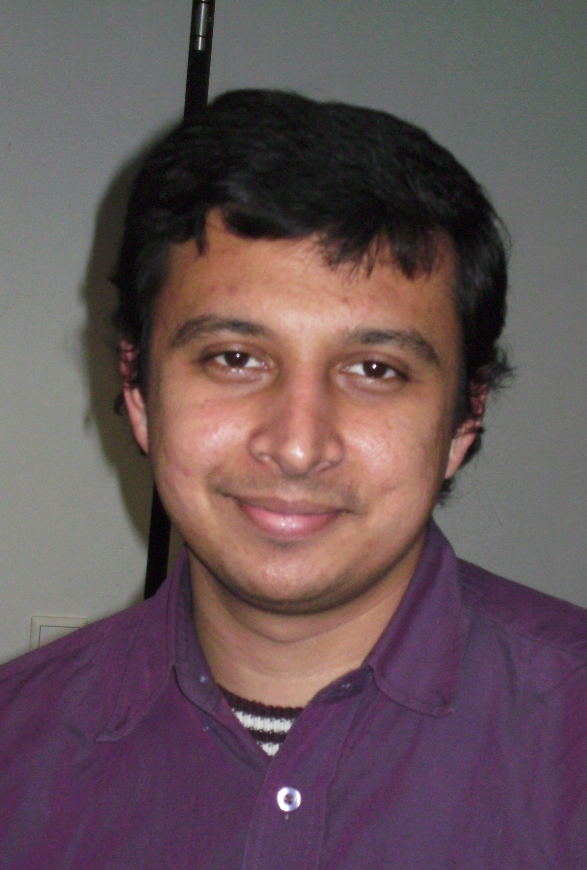
|
|
| |
| Sander did his Master's thesis work under my supervision 2002-2003 when I was postdoc at the AIP in Potsdam. Sander worked on semi-analytical solutions of MHD equations of jet formation considering the force-free Grad-Shafranov equation in Kerr-Metric and also taking into account differential rotation of the magnetosphere. The project was, thus, a follow-up and combination of the PhD work by Elisabetta and my 1997 papers. Read more about this in his Master's thesis which was formally supervised by Vincent Icke of Leiden University (and also defended over there). Sander later did an internship with Rachid Ouyed and then moved on to cosmology. |
Alexander von Benda-Becckmann (Netherlands) 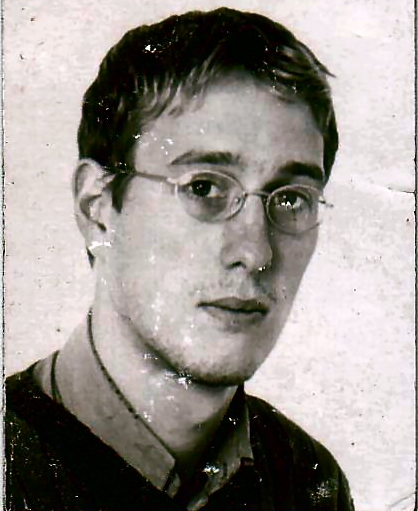
|
|
| |
|
Miki did his PhD 1999-2002 when I was postdoc at the AIP in Potsdam.
He worked on numerical MHD simulations of protostellar jet formation.
After implementing physical magnetic diffusivity into the seminal
ZEUS MHD code,
Miki investigated the influence of jet magnetic diffusivity on
jet acceleration and collimation and also investigated jet launching
from the underlying accretion disk. Read more about the project
Miki's project was funded by the German Science fundation (DFG),
as project DFG/FE490/2-1,2.
Read more about the project
in his
PhD thesis
or in the A&A publication of
diffusive jets
and the IAU proceedings on
jet launching.
Miki has been a JETSET Marie Curie RTN Postdoctoral Fellow at IASA and the University of Athens, and a Visiting Scholar at ASIAA (Academica Sinica, Taiwan). We thank David Clarke, Mike Norman, and Jim Stone for the possibility to use the ZEUS code. |
Miljenko Cemeljic (Croatia) 
|
|
| |
|
Eli did her
PhD thesis 1998-2001 under my supervison
when I was postdoc at the AIP in Potsdam.
She worked on the structure of relativistic MHD jets in particular the
magnetic field distribution when the field lines are rooted in a differentially
rotating disk. For hot plasma ejected in to the jets from the disk she
calculated hypothetical thermal X-ray spectra taking into account
differential Doppler shift and boosting.
Eli's project was funded by the German Science fundation (DFG),
as project DFG/FE490/1-1,2.
Read more about the results in our two A&A publications on the field structure and the X-ray spectra. After her PhD she was a postdoc in Rome, Florence, Harvard, and Milan where she is working up to now (currently at the INFN, Sezione di Milano Bicocca) |
Elisabetta Memola (Italy) 
|